



Rules of the Kubagram® Game
Kubagram® is an engaging family game. The name “Kub-a-gram” is derived from ancient Greek (Kubos = dice / Arithoms = number / Gramma = letter). The game is a word building exercise that enhances and develops vocabulary skills and is also a true test of cunning and numbers, people against people, you against yourself. The game is based on two key elements:
1) 108 dice, called Kubagrams®.
There are 105 regular Kubagrams® and 3 jokers, which are identified by their painted edges, for a total of 108 Kubagrams®. The Kubagrams® are placed inside the rectangular box in 9 rows of 12 Kubagrams®.
Each Kubagram® has a letter and a smaller number engraved on each face. Each Kubagram® side, except on the 3 jokers, is paired with the opposite side and has the same letter engraved on it to form 3 different pairs of letters on each Kubagram®. Each letter also has a numerical value ranging from 1 to 9 engraved on the corner of the face containing the letter. This numerical value is always displayed in the upper right corner of each side of the Kubagram®.
Each and every Kubagram® is unique. Thus no Kubagram® is equal to another Kubagram® in the sense that each Kubagram® has a different trio of letter pairs.
2) “The game box” - a rectangular flat box with 108 squares:
The game box is a rectangular box on the inside bottom of which are drawn 108 squares on which the Kubagrams® are placed. Some squares are marked with the Roman numeral I, others carry the numeral III and yet others carry a 0.
The game requires at least 2 players and can be played with as many as 4 players.
The aim of the game:
The aim of the game is for each player to form as many words, each with a minimum of 5 letters, as possible to attain the highest numerical score. The player with the highest score at the end of the session wins the game.
To make the game easier for young children one can opt to limit the minimum number of letters required to form a word to 3 or 4 instead of the standard 5.
Experienced players can opt to set this minimum of letters to form a word of 6 or more.
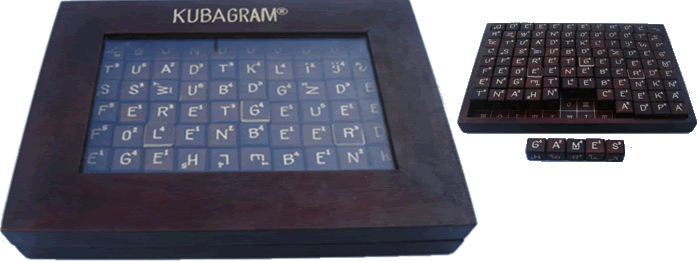

(examples of Kubagram® : different styles)
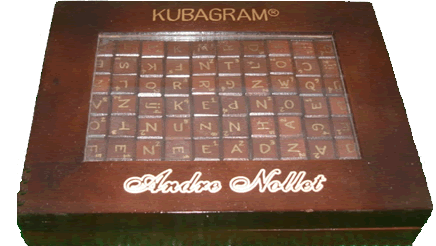
(personalized name engraving possible)
The start and the rules of the game:
Playing fields:
There are 3 kinds of fields: the Kubagram® game box, a central field and player fields (P.F.)
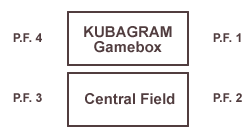
Diagram 1: Playing Fields
a.) The rectangular “game box” with 108 squares is the “field” in which all the Kubagrams® are initially placed.
b.) The central field: this is an area of the table (the table around which the players are seated) in front of the game box. The Kubagrams® are taken out one by one and placed in this area by the players until one player is able to form a word. Only then, after the first player is able form a word can that player move his Kubagrams® to his own player field.
c.) The player fields: are the individual fields around the game box and on the table in front of each player. If a player is able to form a word with the Kubagrams® from the central field, then that player can move the word, i.e. those Kubagrams®, to his or her own player field.
Starting the game:
At the beginning of play all 108 Kubagrams® are shuffled outside the game box and then placed in random order and orientation (i.e. no particular side up or down) on the squares in the bottom of the game box at random.
Each player then takes a Kubagram® without looking and places it in his or her own player field. This Kubagram® is not to be touched from then on.
The player whose Kubagram® shows the letter closest to “A” is now player #1 and may start the game.
If two or more players have the same letter then they must pick another Kubagram® until one is closer to “A”. That player then becomes player #1.
The game starts by taking out a Kubagram® from the lower left corner, from player #1’s position, of the game box. Before play begins and the first Kubagram® is selected, the “last” player has the option to turn the box around to determine which corner will be the starting lower left corner.
Note: it does not matter which corner of the box is the starting corner. However, once a corner is chosen, then that must remain the position of the box for the entire game. The game is then played in clock-wise rotation.
Playing the game:
The first player takes the first Kubagram®, starting in the bottom left corner of the game box, and puts this Kubagram® on the table in the “central field”. This player also has the right to change the arrangement order of the dice that are already in the central field and that player can do that in order to form a word with the minimum number of letters agreed to at the start of game.
The second player takes the second Kubagram®, from the same horizontal row, etc… and puts this Kubagram® next to the first Kubagram® in the “central field”, either to the right or to the left of that first Kubagram®, and this process of taking out Kubagram® and placing those in the “central field” continues to the point a word can be formed. When all the Kubagram® of the first horizontal row have been removed, one starts again from left to right taking Kubagram® out from the next horizontal row, etc…
For those Kubagrams® that were placed on a square with the number I, the following rule applies: only the letter which is visible on the side of that Kubagram® facing up can be used to form a word.
For those Kubagrams® that were placed on a square with the number III, the following rule applies: the player who receives that Kubagram® can use the 3 different sides of that Kubagram®, but the player has to make his or her choice only once: the player can not re-use another side of that Kubagram® once it is put down in the central field after the player has made the choice which letter of that Kubagram® he or she uses.
For those Kubagrams® that were placed on a square with the number 0, the following rule applies: the player who picks up a Kubagram® that was placed on a square with a 0 must pass this Kubagram® to the next player, and that next player can make only 1 selection from the 3 possibilities on that Kubagram®. That player, meaning the player who got a Kubagram® from a square with the number “0” has got his or her turn, meaning that player can not take another Kubagram® until it is again his or her turn after the other players have had their turn.
When a word of 5 or more letters is finally formed by a player then the word may be placed in his or her player-field where it remains visible all players.
A player who’s turn it is to take out a Kubagram® has the right to place that Kubagram® left or right of all Kubagram® that are already taken out and are outside the game box in the central field, in the “central field”, and that player also has the right to change the arrangement order of the dice that are already in the central field. The player can do that to form a 5 letter word; however, this is not recommended because that signals your intention to the next player. It is often better to wait to change the order of the dice until a complete word can finally be made.
Once a Kubagram® has been laid down in the central field by a player, the orientation or the arrangement of the sides, and thus the letters, of these Kubagrams® can no longer be changed by any of the players. A player whose turn it is still has the right to change the order in which the Kubagram® are put down in the central field in order to form a word.
A player who’s turn it is and who sees, even before taking out his or her Kubagram® from the game box, that he or she is be able to form a word with the Kubagram® in the central field, (e.g. the other players before have not seen the possibility to form that word) can claim that word, and thus take the Kubagram® from the central field and form that word and put those Kubagram® in his or her player-field, and then still take a new Kubagram® from the game box.
Each player has the right, during each game, to skip his or her turn once. This can be important towards the end of the game, because the player who takes the last Kubagram® can make use of special rules that apply at the end of the game (see section: “the last Kubagram®”).
Jokers
There are 3 jokers in the game.
The jokers are different than all the other Kubagrams® because they do not have letter pairs and they also have more than 3 distinct letters on their sides.
A player who gets a joker, irrespective of the fact if that joker was on a square with a “III” or a “I”, always can use that joker with a one-time choice from all letters of that joker. However, if the joker was on a square with a “0”, then the player has to pass that joker to the next player.
A player who gets a joker can use that joker immediately, or can put the joker aside for later usage.
A first joker contains 4 different letters (EYGR), a second joker contains 5 different letters (PTOLE), and a third joker contains 6 different letters (ODRKTE).
Every word in which a joker is used has double value (and this applies also to the bonus points in that word, see section “Bonus Points”). A word in which 2 jokers appear gets 4 times the value of the word (and this applies also to the bonus points in that word, see section “Bonus Points”), a word in which 3 jokers could appear, which is exceptional, gets 8 time the value of the word (and this applies also to the bonus points in that word, see section “Bonus Points”).
This doubling of the value of a complete word, when a joker or jokers are in that word, happens irrespective of the place of that joker or those jokers in that word.
Example:
There are 6 letters in the word “cattle”. Suppose the 6th letter “e” is from a joker.
Then score is calculated to be:
C = 1
A = 3
T = 2
T = 2
L = 4
E = 4 + 5 (because the 6th letter gets a bonus of 5 points)
Score = 1 + 3 + 2 + 2 + 4 + 9 = 21,
However, since the 6th letter is a joker, the total score = 21 x 2 = 42
Compounded words:
If a player on his or her turn has formed a word of at least 5 letters and sees a word in another’s player-field that can be used to form a compounded word, then he or she can form this compounded word and claim the total points of the new word. E.g. player 1 formed the word and claimed the points for the word "table", but player 2 can make the word "spoon" and player 2 now notices that he or she can form the word "tablespoon", then player 2 claims the total points for the newly formed “tablespoon”, always provided that is was his or her turn to play.
A player who’s turn it is also allowed to form compounded words with his or her own words that have already been formed and are in the player field.
Example:
Player 1 formed the word “table” and has put that word in his or her player-field, then sees the word “spoon” in his/her own player-field or in the player-field of another player. He or she can claim those words, and form, in his/her player-field the compounded word “tablespoon”
Player 1 is on turn to take a Kubagram®, but sees the word “spoon” in the player-field of another player, and the word “table” in the player-field of that player, or in the player-field of yet another player, then he or she can claim those words, and form, in his/her player-field the compounded word “tablespoon”.
A compounded word formed by 2 different words has 2 times the numerical value of the newly formed compounded word.
A compounded word formed by 3 different words has 3 times the numerical value of the newly formed compounded word.
Scores:
Scores are calculated at the end of the game. The player with the highest total score wins the game.
Bonus points:
When a word of more than 5 letters is formed by a player, then that player gets a bonus for every letter more 5 in the word:
5 points for the first letter over 5 (thus for the 6th letter),
10 points for the second letter over 5 (thus for the 7th letter),
15 points for the third letter over 5 (thus for the 8th letter) and so on.
The bonus points are always added to the score for words longer than 5 letters whether or not the players agreed at the start of the game on a minimum length for words of 3, 4, 6, 7 or more letters.
The last Kubagram®:
This last Kubagram® can result in dramatic changes to the final score. This last Kubagram® can result in either gains or reductions in the final score of the last player.
Negative effect on the score:
Once the last player can not form a word anymore, the total numerical value of the remaining Kubagram® sides facing up still in the central field are added up and then subtracted from the final score of that player.
Positive effect on the score:
A word must always consist of 5 letters or the minimum agreed on by the players, except for the last player at the end of the game. If the last player at the end of the game (i.e. all 108 dice are taken out) cannot form one or more words of 5 letters with the remaining letters, then that player may form words of 2 letters length or more (?with their numerical value preserved?) in order to form other words, such as plurals or ?, of other player’s words or compounded words. For example, one player has formed the word: “compute” and the last player can, with the minimum 2 letters allowed on the last turn, now form “computers” with an “e”, “r”, and “s” left in the central field. That player can now claim this new word, including the double value, even if the value was already double because the word was already formed from a compounded word.
If a player has only one last Kubagram® left from the box, and another player still possesses in his or her player field an unused joker, then 2 possibilities exist:
Either the last player takes that joker, and uses it to form a new word or a new compounded word, applying all the rules with regard to bonus points, other jokers in those words, etc…
Or, the last player does not take that joker, and then the player who retains the joker is penalized by the numerical value of all the sides of that joker being subtracted from the total score of that player.
Special rules:
Whenever there are 10 consonants and no vowels in the central field, then the player whose turn it is according to the rules of the game, must choose - from the Kubagram® he or she selects - a vowel. For example, if a player takes out a Kubagram® on a square with an “III”, then that player must use the vowel on that Kubagram®. If the player gets a Kubagram® from a square with an “I”, and the upper side shows a consonant, then the player must put the Kubagram® down with the vowel on the upper side. In case a player takes out that Kubagram® from a square with a “0”, and thus has to give that Kubagram® to the next player, then that next player must also use the vowel on that Kubagram®. If a player gets a joker in this situation with 10 consonants and no vowels showing, then that player must use a vowel on that joker and cannot put the joker aside for later usage.
Note: For Kubagram®, “Y” is considered as a consonant.
Allowed words:
All words which are featured and listed in "Webster’s Dictionary" are valid and may be used, except abbreviations and acronyms, which are indicated in that dictionary with periods between the letters.
To increase the intellectual challenge of the game, it is not allowable to use so-called “loaner-words”. These are words that can be replaced by a word from another language (such as Latin) or are abbreviations which have became words by themselves (e.g. UNCTAD)
If a player uses the Webster’s (or Oxford) Dictionary to verify that a word exists or not, then that player may lose 5 points if the claimed word is not in fact NOT a proper English word.
|
|
||||||||||||||||||||||||||||||||||||||||||||||||||||||||||||||||||||||||||||||||||||||||||||||||||||||||||||||||||||||||||||||||||||||||||||||||||||||||||||||||||||||||||||||||||||||||||||||||||||||||||||||||||||||||||||||||||||||||||||||||||||||||||||||||||||||||||||||||||||||||||||||||||||||||||||||||||||||||||||||||||||||||||||||||||||||||||||||||||||||||||||||||||||||||||||||||||||||||||||||||||||||||||||||||||||||||||||||||||||||||||||||||||||||||||||||||||||||||||||||||||||||||||||
|
|||||||||||||||||||||||||||||||||||||||||||||||||||||||||||||||||||||||||||||||||||||||||||||||||||||||||||||||||||||||||||||||||||||||||||||||||||||||||||||||||||||||||||||||||||||||||||||||||||||||||||||||||||||||||||||||||||||||||||||||||||||||||||||||||||||||||||||||||||||||||||||||||||||||||||||||||||||||||||||||||||||||||||||||||||||||||||||||||||||||||||||||||||||||||||||||||||||||||||||||||||||||||||||||||||||||||||||||||||||||||||||||||||||||||||||||||||||||||||||||||||||||||||||